
Authors



Samuel Beckwith and Deja Logan are co-lead authors
Introduction
Youth engagement is the cornerstone of developing effective programming for adolescents, yet many youth-serving professionals struggle to move beyond collecting surface-level input from youth to instead collaborate more authentically. For example, youth-serving programs may invite youth to contribute their voice but then fall short in integrating their feedback, or fail to engage them early enough to shape key decisions. Thankfully, adolescent health researchers, youth-supporting professionals, policymakers, and young people themselves have stepped forward to address this challenge by developing new ways of thinking about youth engagement—as a multifaceted, ongoing, and dynamic process.
This resource aims to address the challenge of authentic program collaboration with youth by providing frontline facilitators and other youth-supporting professionals with a practical framework for understanding youth engagement, along with several case studies. Concrete examples and guided self-reflection will help you build skills to understand where your program stands with regard to youth engagement and identify clear ways to strengthen engagement in authentic and sustainable ways. Whether you are just beginning to explore or looking to deepen existing efforts, you’ll leave with fresh insight for creating stronger, more responsive programs for the young people you serve.
Classifying Youth Engagement
Youth engagement may be broken into three main dimensions: the roles in which youth may engage, the ways in which youth are engaged, and the various supports they are offered for engagement.
Youth roles
When authentically engaged, a young person may take on one of three roles within a program:
- Speaking, or being able to share their ideas and opinions with adults who are in charge
- Co-designing, or partnering with adults to lead an effort together
- Designing, or being the primary decision makers and drivers of an effort while adults assist
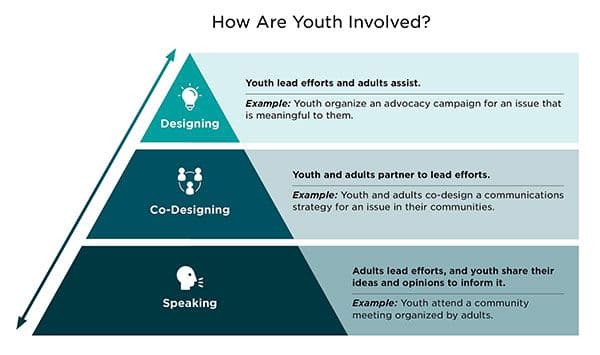
These roles may change over time as youth transition in and out of leadership or participation in a program. Programs may also engage youth in a mix of roles, with different youth serving as designers, co-designers, or speakers at any given time. Additionally, none of these roles are inherently superior to the others. While having youth as designers provides the most agency of the three roles, it is likely that fewer youth will be able to serve as designers rather than as speakers. Some youth may also feel more comfortable working in a particular role (e.g., as a speaker) than in others. Offering opportunities for youth in your program to serve in all three roles—and to choose or adjust the role they serve—supports their leadership development and reflects the fluid and dynamic nature of authentic youth engagement.
Ways of engaging youth
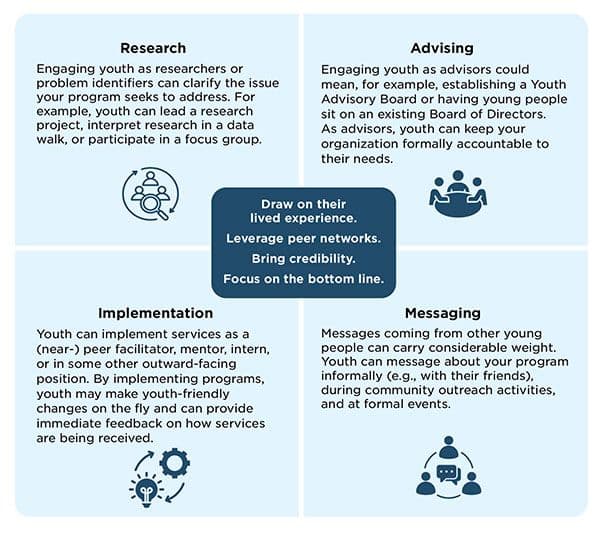
There are many different ways to engage youth in programming. Youth engagement can include:
- Researching, where youth gather or interpret data to shape your organization’s work
- Advising, where youth serve formally on boards or in other leadership positions
- Implementing, where youth deliver services “on the ground”
- Messaging, where youth advocate for your organization to outside parties
These articulated ways of engaging youth are neither exhaustive nor mutually exclusive. Just as it is beneficial to have multiple roles for youth—as speakers, designers, or co-designers—it’s also helpful to allow different forms of engagement. Youth engagement can vary in structure and commitment, from formal, long-term roles to short-term or more sporadic opportunities. Some youth may feel more drawn by opportunities to implement your organization’s programming, while others may fall more naturally into research, messaging, or advising activities. Depending on the scope of your organization’s work, youth may engage in multiple different ways at one time.
Supporting youth engagement
Supports for youth engagement can include both organizational structures and meaningful connections:
- Structures include the ways that youth are centered in an organization and its work, practices that support youth engagement, and resources that are meaningful to youth. Examples of structures could include stated values (e.g., a belief in the benefits of youth engagement), norms that promote respect between adults and youth, flexibility (including transportation supports), training offered to young people, and compensation for youth’s time.
- Connections include both those between peers and between youth and adults, as well as connections to future benefits or opportunities. Examples of connections include building an inclusive, safe community space for youth to gather; providing mentoring; or connecting youth with internship opportunities within the organization or with a trusted partner.
Common Considerations for Youth Engagement
While authentic engagement of youth confers benefits—both to the youth themselves and to the effectiveness of an organization’s work—it is a nuanced and sometimes challenging process. Some common pitfalls and tips for navigating these are listed below.
- Adults should recognize young people’s capabilities and set high expectations. However, adults must also provide an appropriate level of support to help youth meet these expectations. Setting high expectations without offering personal and professional development supports may leave all parties frustrated.
- Youth engagement activities should be set up in a youth-friendly way and account for the day-to-day lives of the youth with whom you work. Consider youth’s school, work, extracurricular, or caretaking responsibilities: Are there ways that you can partner with local schools to deliver activities where youth are?
- Ideally, youth should be paid for their time participating in youth engagement activities. In-kind contributions, like providing meals or snacks during activities, are also usually welcome.
This resource builds on existing work by Child Trends and its partners—including youth partners—related to youth engagement. In particular, it draws on the Authentic Youth Engagement in Policy Framework and extends it to youth engagement more broadly.
The following case studies are intended to build the capacity of frontline practitioners and other youth-supporting professionals to better engage youth in programming. By engaging with the case study scenarios, you will:
- Identify different stages at which youth may be engaged and the specific roles they can play.
- Understand how different organizational supports and available connections can promote effective youth engagement.
- Recognize opportunities to strengthen youth engagement and the practices that promote it in your own organization’s day-to-day work.
Using This Module
This learning module presents fabricated yet realistic scenarios you may encounter in program, research, or policy settings. As you read and discuss them, focus on:
- The role(s) youth are playing
- The ways youth are being engaged
- The structures that support or hinder meaningful youth engagement
While we have provided sample responses to each question, these reflect just one interpretation of the scenarios. The goal is not to find a single “right” answer, but rather to explore different ways of making youth engagement more authentic and impactful.
Scenarios
Case 1
A small research organization is applying for a grant to conduct a youth-led community-based research study on school nutrition in a major city. The funder prioritizes applicants who develop research questions in collaboration with youth.
Although the organization’s staff hold extensive expertise in conducting research related to youth, very few have experience directly engaging youth as research partners and/or leaders. Only one staff member is connected to youth in the city through their existing volunteer work at a youth program; the rest lack direct, consistent access to youth networks.
Currently, youth are not proposed to serve as speakers, co-designers, or designers in this effort.
Learning questions:
- Based on the organization’s engagement with youth to date, what role(s) should youth play in this research project (e.g., speakers, co-designers, designers)?
- What way(s) of engaging youth would fit well under this initiative?
- What concrete steps could this research organization take to meaningfully engage youth in this role?
- What organizational supports, partnerships, or resources would help the organization strengthen youth engagement capacity?
Sample responses:
- Because the funder prioritizes research questions designed in collaboration with youth, the research organization should include youth as co-designers. To inform the research background section of their grant application, the organization may choose to engage additional youth as speakers to identify what they are most interested in learning about school nutrition.
- This initiative could include youth as researchers and/or advisors. As researchers, youth could look into relevant information about school nutrition in their city and use that to develop research questions. As advisors, they could provide input on draft research questions or background information to shape the funding application.
- One concrete step could be to strengthen connections with youth in the city. The organization could conduct outreach to youth-led organizations or clubs relevant to the funding application to initiate a partnership.
- One high-priority organizational support/resource would be to provide staff with training on Youth Participatory Action Research (YPAR). Because staff are not used to working alongside young people, they likely need additional capacity to begin youth engagement in earnest.
Case 2
A youth-serving nonprofit organization delivers a high school sexual health education program using paid peer facilitators. While previous peer facilitator cohorts implemented the program as written, the most recent cohort believes the curriculum and activities are outdated. At the last meeting between the cohort and adult staff, the peer facilitators recommended making changes midway through implementation.
Typically, the organization’s standard practice is to consider curriculum revisions only after a program cycle ends. Staff are unsure how to incorporate youth voices without disrupting the program and feel a tension between their obligations to youth and organizational management.
Learning questions:
- The youth in this effort are speakers, but not able to co-design improvements due to organizational pushback. What organizational structures or norms are limiting youth’s ability to co-design or improve the curriculum?
- How might the organization adapt its processes to allow youth to meaningfully shape programming while it is underway?
- What existing strengths or experience does this organization have that can support deeper/continued youth engagement?
Sample responses:
- A clear barrier to co-design is the organization’s policy against making changes during the program cycle. More broadly, norms that promote “business as usual” over responsiveness to youth partners could block deeper youth engagement efforts.
- Staff could organize regular meetings (e.g., every two weeks) where peer facilitators can provide actionable feedback on how things are going. Ideally, these meetings would include youth, frontline staff, and management/leadership to promote closeness and responsiveness to youth at all levels of the organization.
- Having an existing peer facilitation model is an organizational strength because youth are already regularly engaged in implementation activities. This model could serve as an on-ramp to other ways of engaging youth—for example, including them as advisors (e.g., board members).
Case 3
A midsize foundation funds nonprofit organizations working to reduce community violence. For the first time, it has invited youth leaders in the gun violence prevention space to review grant applications. However, in addition to being unfamiliar with seeking youth voice, the foundation has provided limited training to support young people’s reviews. Further, the foundation did not include youth leaders in interviews or funding selection meetings. Although youth submitted written feedback, their perspectives were ultimately not used to shape the funding decisions.
Learning questions:
- The foundation sought to engage youth as speakers who provided input on applications. However, youth perspectives were not honored or heard. If a funder wants youth to serve as true partners in grant selection, what structures or processes need to be in place?
- What supports or connections might youth reviewers need to engage confidently and effectively?
- How might failing to meaningfully incorporate youth perspectives affect future youth engagement or the foundation’s credibility?
Sample responses:
- To engage youth as true partners, the funder could embed youth engagement and transparency throughout the full grantmaking process. This would involve defining youth roles and decision-making authority at the outset, establishing formal mechanisms to capture and incorporate youth feedback, and including youth in key stages such as applicant interviews, deliberation meetings, and final selection discussions.
- Youth reviewers can benefit from an application review training and orientation to philanthropy, grantmaking criteria, and decision-making norms. Regular meetings with foundation staff dedicated to youth engagement could provide youth reviewers with ongoing support throughout the grantmaking process (e.g., space to ask questions without judgement).
- Deciding not to incorporate youth perspectives may lead to disengagement, mistrust, and reluctance to participate in future foundation initiatives. Youth leaders may rightly feel their involvement was only symbolic, which can damage trust with them and other youth-led groups and weaken the foundation’s credibility over time.
Case 4
State legislators recently passed a law requiring all school districts to develop and enforce policies restricting cell phone use during the school day. In response, one school district has assigned a staff member to take the lead on policy development.
The district has very limited experience engaging students in making decisions. Their only formal structure for student voice is a nonvoting student representative on the school board. The staff member leading the policy development is interested in student co-design, believing that student input and buy-in is necessary for the policy to be implemented and enforced. This staff member is especially interested in working with students to clarify instances for which cell phone use is appropriate (e.g., emergencies, field trips) and to determine consequences for violating the new policy. However, the staff member is not confident they will receive full administrative support for deeper youth leadership in policy development.
Learning questions:
- What are two ways the staff member can engage students as speakers this year to ensure that the cell phone policy is responsive to youth input—even without full co-design structures in place?
- What ways of engaging youth (e.g., in research, implementation, advising, or messaging) could empower youth to participate in policy development?
- What additional supports or connections are needed for the cell phone policy to succeed?
Sample responses:
- The staff member could field a schoolwide survey for students to share their perspectives on appropriate cell phone usage and appropriate consequences for violating the policy. The staff member could also organize student listening sessions during staff or school board meetings to allow students to present their viewpoints, share real-life examples, and answer questions.
- The district and staff member could engage youth in research by collecting data about current cell phone usage, perceptions, and impacts on learning among their peers. Youth could also help the staff member make flyers—and newsletter or social media content—to communicate the policy to students. They could also support implementation through pilot testing parts of the proposed policy in classrooms and reporting back on both successes and challenges.
- The school district can provide trainings to build capacity for both the staff member and students to conduct youth-adult partnerships and policy co-design. In addition, connecting the staff member and student participants with other districts or youth engagement experts can provide guidance and best practices for implementing youth input. Compensation for students’ time and contributions would also support meaningful engagement.
Helpful resources
- ACT for Youth: What is Youth Engagement, Really?
- Annie E. Casey Foundation: A framework for authentically partnering with young people
- Break The Cycle Research Team: Learnings From Youth-led Community Events to Address Community Violence in Washington, DC
- Child Trends: Authentic Youth Engagement in Policy Project
Suggested citation
Beckwith, S., Logan, D., & McClay, A. (2026). Case studies to build facilitators’ youth engagement skills. Child Trends. DOI: 10.56417/8596t1901y