



October is National Financial Planning Month, a reminder to track one’s finances, set goals, and create plans and budgets to reach them. The ability to manage finances well in adulthood starts with conversations children have with their parents at home. Our new analysis of nationally representative data (see “Methods”) shows that most parents have talked to their children about money or finances at some point in their lives, and that they use a variety of strategies to teach their children. Early conversations about money may have far-reaching benefits for children, including improved financial habits and mental, physical, and relational well-being. This openness gives parents an opportunity to strengthen children’s financial capabilities with practical concepts and tools for lifelong financial well-being.
An overwhelming majority of parents have talked to their child about money.
Most parents (87%) with a child ages 8 to 18 have talked to them about money or finances (e.g., saving, spending, budgeting, or earning money) at some point in their lives.
Figure 1. Most parents have talked with their child about money or finances
Percentage of parents reporting they have ever talked with their child about money or finances, overall and by subgroup (N=943), 2025
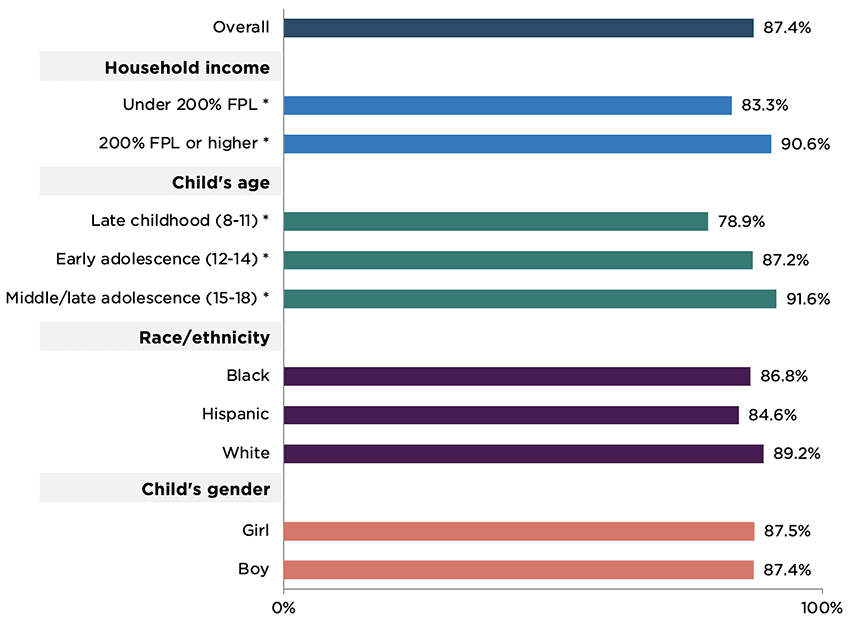
Note: FPL = federal poverty line
Source: Child Trends analysis of a 2025 survey of parents/caregivers with a child ages 8–18. * Statistically significant difference across that subgroup's categories (p < .05). Differences by race and ethnicity and by child's gender are not statistically significant. The survey was administered in English only and may not represent the experiences of parents who are not yet fluent in English.
While substantial majorities of parents have talked to their children about finances regardless of household income, child age, race or ethnicity, and child gender, conversations are somewhat more common among higher-income households and parents of older children. Ninety-one percent of parents in households at or above 200 percent of the federal poverty line reported ever talking with their child about money or finances, compared to 83 percent of households below that threshold. Parents were also more likely to have talked with their child about money or finances if their child was older: 92 percent of parents with a child ages 15–18 had done so, compared to 87 percent of parents with a child ages 12–14 and 79 percent of parents with a child ages 8–11. The percentage of parents who had talked with their child about money or finances was similar for Black, Hispanic, and White parents, and did not differ by child gender.
Parents who have not yet talked with their children about money often plan to do so in the future.
Among parents who reported that they had not yet had conversations with their children, 38 percent indicated that they thought their child was too young; 35 percent reported that they planned to talk about money or finances with their child in the future.
Figure 2: Most parents who have not yet talked with their child about money say it is a matter of timing
Percentage of parents citing each reason for not yet talking with their child about money or finances, among parents who have not yet done so (N≈105–119)
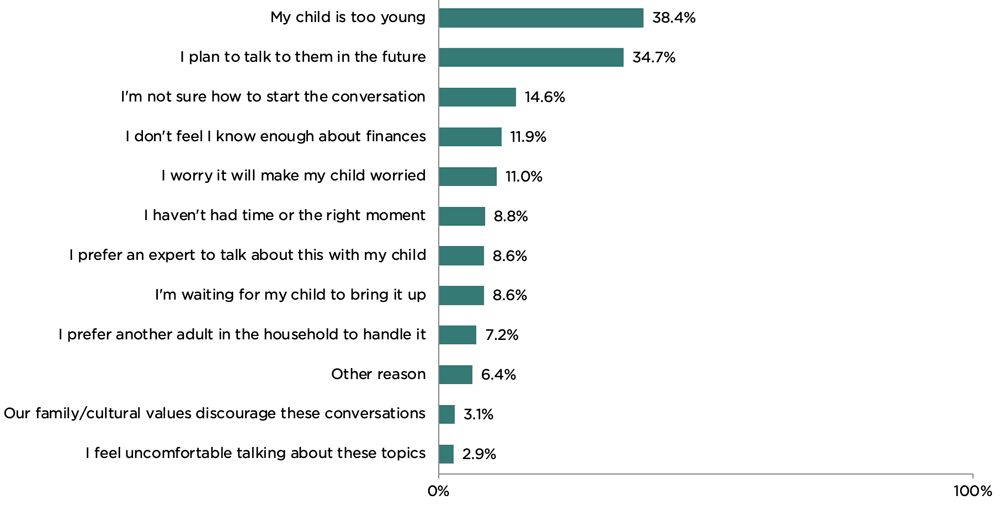
Source: Child Trends analysis of a 2025 survey of parents/caregivers with a child ages 8–18. Respondents could select more than one reason, so percentages do not sum to 100 percent.
Other reasons for not talking about money included parents’ uncertainty about how to start a conversation (15%), not feeling like they knew enough about finances (12%), and concerns about making their child worry about money (11%). Less than 10 percent of participants indicated that they had not engaged in financial conversations because the right time had not come up, because they preferred to have a professional or other adult handle the conversation, because they were waiting for their child to bring it up, or due to family or cultural norms around financial conversations.
Parents use a variety of strategies to help their children learn about money.
Parents transmit financial knowledge to their children in different ways: talking with them about money, setting a good example, and/or providing opportunities for hands-on experiences with money and finances. For the most part, parents respond to their children’s questions about money when asked (84% of parents). Many parents teach their children during everyday activities such as trips to the store or bank (62%), share their own past financial experiences (60%), and openly discuss the household budget with their child (53%). Parents also model financial behavior for their children. Most try to be a good example when it comes to managing money (68%) and emphasize the importance of saving for purchases rather than going into debt (66%), although fewer make their financial habits visible to their child—e.g., tracking expenses (49%) or using a budget (37%). Finally, many parents encourage their child to set money aside for savings or donations (60%), provide hands-on experiences with money (58%), and offer opportunities to practice managing money (56%).
Figure 3: Parents use a variety of strategies to teach their children about money
Percentage of parents who strongly agree or agree with each statement about supporting their child's money learning (N≈830-939), 2025
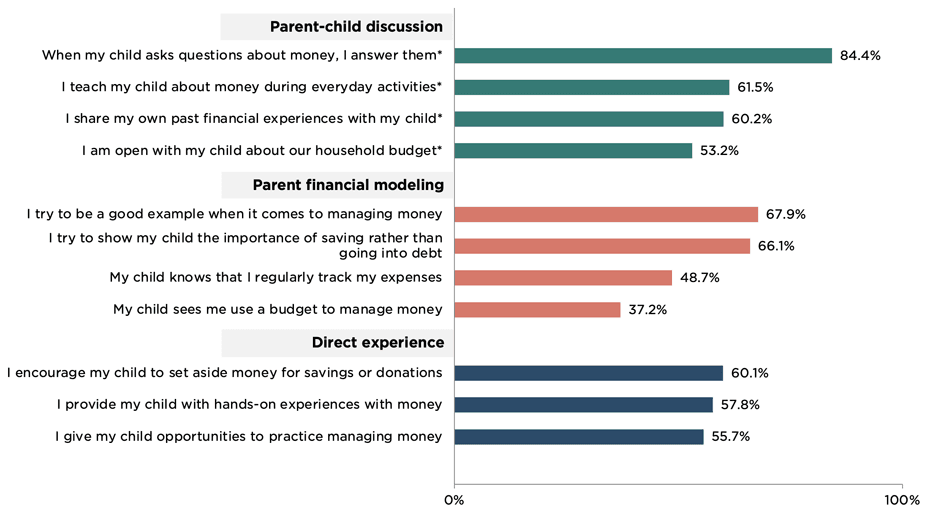
Source: Child Trends analysis of a 2025 survey of parents/caregivers with a child ages 8–18. Response scale collapsed from 1 (strongly disagree) to 7 (strongly agree) into 'strongly agree/agree' vs. other.
*These items were asked only of respondents who indicated they have talked with their child about topics related to money or finances. All other items were shown to all survey respondents.
These data paint a largely positive picture of family financial socialization: Most parents are already teaching their children about money and using a variety of tactics to do so. For the most part, those who have not yet engaged in these conversations are not hesitant to broach the topic, but simply plan to do so in the future. As new efforts to increase families’ savings and wealth (e.g., baby bonds, 530A/Trump Accounts) go into effect, pairing them with supports to build financial knowledge and skills may help children and families make the best of the opportunities available.
This survey was designed by Child Trends using an adapted version of the Parent Financial Socialization Scale. The survey was administered through AmeriSpeak®, a nationally representative survey panel of U.S. households. Data were collected in English in December 2025 using both an online survey and telephone interviews. This analysis used a subsample of 943 parents and caregivers of children ages 8 to 18. Survey weights were applied to align the sample with demographic characteristics of the Current Population Survey from the U.S. Census Bureau, including sex, age, education, race/ethnicity, and region. We conducted Pearson’s chi-squared tests of independence to assess whether the distribution of responses for the survey item regarding whether parents and caregivers had talked with their child about money or finances differed by child age, household income, race/ethnicity, and child gender. We adjusted for multiple comparisons by applying the Benjamini-Hochberg procedure to limit the false discovery rate.
Acknowledgements
The authors would like to thank Emily Maxfield for her support with analyses and Lina Guzman for her review.
Suggested citation: Ramos-Olazagasti, M., Falletta, K., & Ramirez, L. (2026). Most parents have talked to their kids about money or finances. Child Trends. DOI: 10.56417/1470w2663o