
More infants participating in home visits funded through the Maternal, Infant, and Early Childhood Home Visiting (MIECHV) Program are being breastfed than in prior years. Data from the MIECHV Outcomes Dashboard show that 45 percent of enrolled infants received any breast milk at 6 months of age in fiscal year (FY) 2024 (up from 36% in FY 2017). MIECHV Program funding provided more than 75,000 families with home visits in 2024.
A long history of research has shown that home visiting programs, such as the evidence-based two-generation programs funded by the MIECHV Program, can improve outcomes for families and children. These programs provide a number of services to meet families’ needs, including information on breastfeeding and nutrition. For instance, during home visits, trained professionals known as home visitors may screen children for developmental delays and screen mothers for depressive symptoms.
Research has shown that, as home visitors more frequently talk with families about breastfeeding, their likelihood of continuing to breastfeed increases. Home visitors also link families to other related resources and services in their community; for example, they can connect families with lactation support, breastfeeding support groups, and supplies like breast pumps. Breastfeeding support is just one way that home visitors work with families around health and nutrition.
The percentage of infants in families enrolled in the MIECHV Program who received any breast milk at 6 months of age has risen since FY 2017
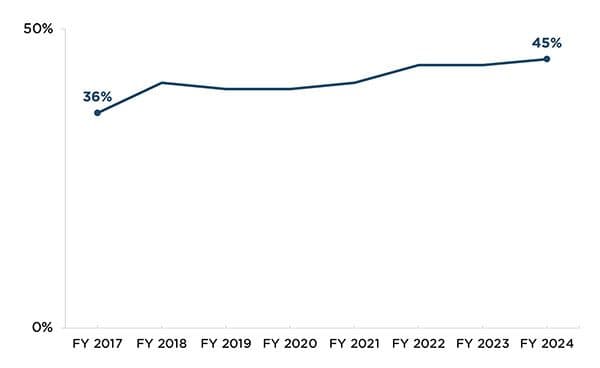
Source: Data from the Health Resources and Services Administration MIECHV Program Dashboard: https://data.hrsa.gov/topics/maternal-child-health/miechv
Although rising, the rate of breastfeeding at 6 months among MIECHV families remains somewhat lower than national rates—in 2022 (the most recent year for which national data are available), the rate was approximately 62 percent among all families and 56 percent among families with incomes less than 200 percent of the poverty level (a priority population for the MIECHV Program).
Child Trends and Home Visiting
Child Trends experts have extensive experience researching and supporting home visiting. Our multidisciplinary team works with federal, state, local, and philanthropic partners to evaluate and strengthen home visiting programs. Recent publications highlight strategies to increase recruitment and uptake of home visiting, to build policies that support the home visiting workforce, and to examine implementation quality using a conceptual framework.
In addition, we helped the Health Resources and Services Administration design the MIECHV Program Outcomes Dashboard. We also provide support to state and federal home visiting programs through data analysis, data visualization, technical assistance, and policy development. If you are interested in learning more about our work on these topics, please contact Sarah Crowne or Christina Padilla.